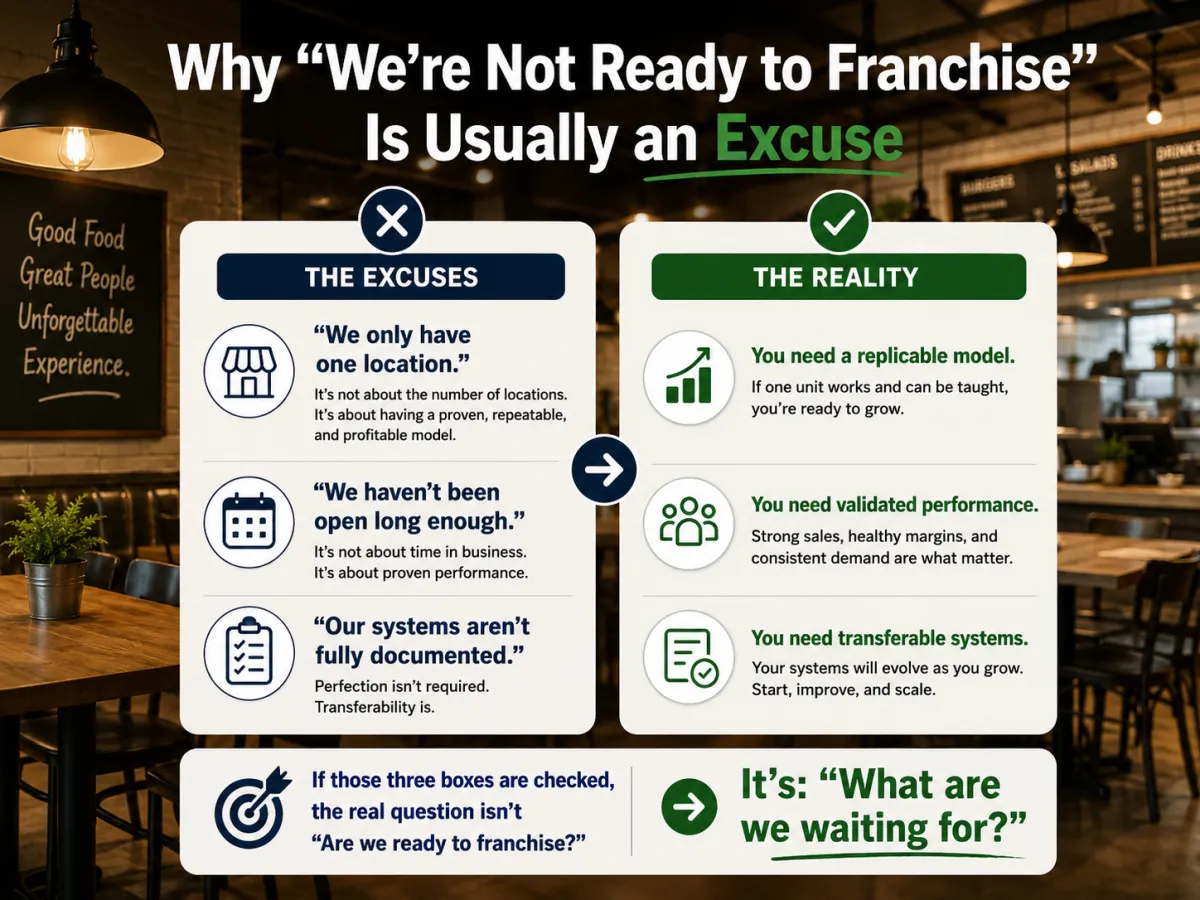
Why “We’re Not Ready to Franchise” Is Usually an Excuse
Why “We’re Not Ready to Franchise” Is Usually an Excuse
Business owners rarely say “I’m afraid to franchise.” Instead, the hesitation shows up dressed as logic. On the surface, many of these reasons sound responsible—even prudent. But in practice, they often become convenient ways to delay a growth opportunity that’s already viable.
Here are three of the most common excuses—and why they don’t hold up under real-world scrutiny.
1. “We only have one location.”
This is probably the most frequent objection—and also one of the weakest.
Plenty of successful franchise brands began franchising with a single flagship unit. What matters isn’t the number of locations, but whether the concept is proven, repeatable, and profitable.
Wingstop began franchising with a very small footprint centered around a strong prototype. Their early franchisees didn’t need a massive corporate footprint—they needed a concept with clear demand and unit-level economics that worked.
Closer to home, many emerging food brands test everything in one high-performing location: menu, pricing, staffing model, and customer flow. If that one unit consistently produces strong margins and can be taught to someone else, it’s already functioning as a prototype.
Reality check:
A second or third corporate location can provide additional data—but it’s not a prerequisite. In fact, waiting too long often means missing the window when your concept is most differentiated.
2. “We haven’t been open long enough.”
Longevity feels like safety. But time alone doesn’t validate a concept—performance does.
If a business has strong sales, healthy margins, and consistent customer demand over 12–24 months, that’s often more meaningful than simply existing for five years with average results.
The Halal Guys built a massive following from a single New York City food cart before expanding and franchising. Their “proof” wasn’t years in operation—it was lines around the block and repeat customers.
Similarly, modern fast-casual brands often scale quickly because they identify product-market fit early. They don’t wait for arbitrary timelines—they act on validated demand.
Reality check:
If your unit economics are strong and your concept has traction, waiting for an arbitrary anniversary date doesn’t reduce risk—it just delays growth.
3. “Our systems aren’t fully documented.”
This one sounds responsible—and to a degree, it is. Systems matter. But the idea that everything must be perfectly documented before franchising is a myth.
In reality, documentation evolves alongside franchising.
Jimmy John’s grew rapidly in its early years with relatively simple, operationally focused systems. Their manuals and processes became more robust as the franchise network expanded—not before.
Many franchisors start with a solid operational foundation—recipes, training processes, daily checklists—and refine their manuals with input from early franchisees.
Reality check:
If you wait until everything is “perfect,” you’ll never start. The goal isn’t perfection—it’s transferability. Can someone else follow your model and get a similar result? If yes, you’re closer than you think.
The Bigger Truth
Most of these excuses aren’t really about readiness—they’re about risk tolerance and uncertainty.
Franchising is a shift from operator to brand builder. That requires letting go of some control and trusting that your model can work in someone else’s hands.
But here’s the irony: the longer you wait, the more risk you often create. Competitors enter your space. Your concept loses its novelty. Expansion opportunities get more expensive.
Bottom Line
You don’t need multiple locations—you need a replicable model.
You don’t need years—you need validated performance.
You don’t need perfect systems—you need transferable ones.
If those three boxes are checked, the real question isn’t “Are we ready to franchise?”
It’s: “What are we waiting for?”